Agents Don't Fix Broken Decisions. They Automate Them Faster.
Agentic AI scales whatever decision process you already have. If that process is broken, agents just break things faster.
The Agent Pitch Everyone Is Buying
Every vendor demo I've sat through in the last six months ends the same way. A slide with autonomous agents handling procurement, customer service, claims review, pricing, whatever vertical they're selling into. The pitch is always speed. Agents that work 24 hours a day, make decisions without waiting for a human, and scale instantly across thousands of transactions.
I believe the technology. I've built agentic systems that genuinely cut cycle time and reduce manual load. What I don't believe is the implicit promise sitting underneath the pitch: that agents make better decisions than the humans and processes they're replacing.
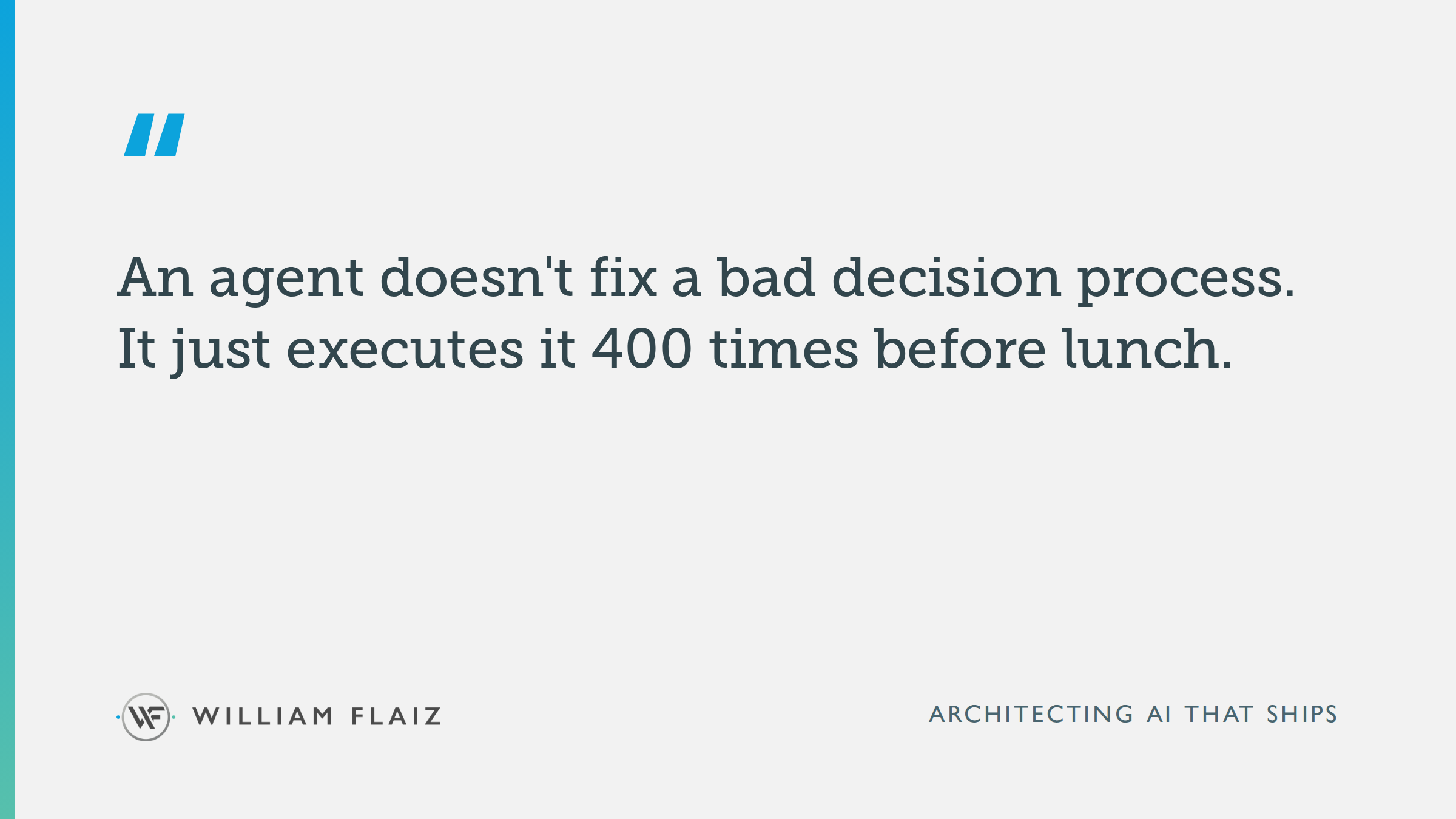
Here's the claim I keep making to CDOs and it lands differently every time. An agent doesn't fix a bad decision process. It just executes it 400 times before lunch instead of 40. Speed is not the same thing as correctness, and in 2026, that distinction is going to separate the companies that scale value from the ones that scale damage.
Agents Inherit the Decision Layer, They Don't Audit It
An agent is, at its core, a decision executor wired to tools and triggers. It takes the logic you give it, the data you feed it, and the thresholds you set, and it runs. It does not pause to ask whether the underlying rule still makes sense. It does not notice that the approval threshold was set in 2019 and never revisited. It just runs the rule, fast and consistently, at a scale no human team could match.
I worked with a pharma commercial operations team last year that wanted to deploy agents to auto-approve field sample requests based on rep tier and territory volume. Reasonable on paper. Except the underlying approval logic had never accounted for a 2021 compliance change, and nobody had cleaned it up because the manual review process quietly absorbed the gap. Humans were compensating for a broken rule without anyone documenting it.
We caught it during a workshop, not after deployment. If that logic had gone live inside an agent, it would have auto-approved several thousand non-compliant requests in the first quarter alone, at machine speed, with a clean audit trail showing the agent did exactly what it was told. That's the part people miss. The agent isn't the risk. The decision layer underneath it is, and the agent just removes the human buffer that used to catch the mistake.
This is the pattern I see across every industry now: the decision logic was never the clean, documented thing leadership assumed it was. It was held together by tribal knowledge, manual overrides, and judgment calls nobody wrote down. Agents expose that instantly because they can't exercise judgment they were never given.
Where Agents Genuinely Belong
None of this means agents are overhyped as a category. It means they're misapplied as a category. The organizations getting real value from agentic AI right now are deploying them in a specific zone, and it's narrower than the vendor decks suggest.
Agents belong where the decision is well understood, the rules are stable, and the cost of an error is low and reversible. Think routing a support ticket to the right queue, reconciling two datasets against a known schema, drafting a first-pass response that a human reviews before it ships, or flagging anomalies against a threshold that's been validated and stress tested.
In those zones, I've seen agents cut processing time by 60 to 70% without adding risk, because the decision being automated was already sound. The agent isn't making a new kind of call. It's making the same call humans were making, just faster and without fatigue-driven inconsistency.
The common thread: someone already did the hard work of defining the decision correctly before the agent touched it.
Where Agents Compound Risk
The danger zone is the inverse. High-stakes decisions, ambiguous criteria, or logic nobody has pressure tested recently. This is where agentic deployment turns a slow, manageable problem into a fast, expensive one.
I've started asking a simple question in every agent scoping session: if this decision goes wrong, how many times will it go wrong before a human notices? With a manual process, the answer is usually one, maybe a handful, before someone flags the pattern. With an agent running at machine speed across a full population, the answer can be thousands, and the financial or compliance exposure scales just as fast.
A few patterns that consistently signal an organization is about to automate dysfunction rather than fix it:
If any of those are true, deploying an agent doesn't remove the problem. It removes the only thing that was slowing the problem down.
- The decision rule exists in someone's head, not in documentation
- Humans are quietly overriding the stated process more than 10-15% of the time
- Nobody can explain why the current threshold or rule was set where it is
- The data feeding the decision has known quality issues that 'everyone just works around'
- The decision has real financial, compliance, or patient-safety consequences if wrong
Audit the Decision Before You Automate the Action
The fix isn't complicated, but it's unglamorous, which is probably why most organizations skip it. Before any agent touches a decision, map the decision logic as it actually operates today, not as the policy document says it should. That means talking to the people doing manual overrides and finding out why.
At Novartis, the 52% cost reduction we drove across 1,200-plus websites didn't come from automating faster. It came from standardizing and auditing the underlying content and governance decisions first, then automating what was left. Automation was the last step, not the first.
The same sequence applies to agents. Audit the decision. Fix what's broken. Document the logic explicitly. Then automate it. Skip the first three steps and you haven't deployed AI, you've deployed your dysfunction at scale, with a faster clock and a cleaner-looking dashboard.
For CDOs and VPs of Strategy building 2026 agent roadmaps, the question isn't which process to automate first. It's which decisions in your organization have never actually been audited, only inherited. Start there.
Frequently Asked Questions
Why do AI agents make bad decisions worse instead of better?
Agents execute the decision logic they're given, they don't evaluate whether that logic is sound. If the underlying rule is outdated or was quietly corrected by human overrides, the agent removes that correction layer and runs the flawed rule at full speed and scale.
How do I know if a process is safe to hand to an agent?
Check whether the decision logic is fully documented, whether humans override it less than 10-15% of the time, and whether an error would be low cost and reversible. If any of those conditions fail, audit the decision before automating it.
What's the first step in deploying agentic AI responsibly?
Map how the decision actually operates today, including informal overrides, before writing a single automation rule. A short, structured workshop to audit decision logic almost always surfaces gaps that would otherwise get automated by default.