The Reskilling Trap: Why Most Enterprise AI Training Programs Are Teaching the Wrong 20%
Your enterprise AI training program is probably reskilling people for the 80% that AI will replace anyway. Here's how to build capability around the 20% that actually matters.
The Reskilling Boom Nobody Is Auditing
A pharma client of mine spent $4.2M last year on an enterprise AI training program. Every employee, from regulatory affairs to field sales, went through modules on prompt writing, copilot navigation, and how to fact check a chatbot's output.
Nine months later, satisfaction scores were high. Usage adoption looked great on the dashboard. But when I asked leadership what had changed about how decisions actually got made in the org, nobody had an answer.
That's the pattern I'm seeing across every industry right now. Companies are spending real money on reskilling, and most of it is aimed at teaching people to operate tools that will need less and less human operation every quarter.
What Programs Actually Teach vs. What They Should
Walk into almost any corporate AI training deck and you'll see the same skeleton: how to write a good prompt, how to use the enterprise copilot, how to spot a hallucination, maybe a module on responsible AI use. Call this the execution layer. It's real work, and yes, people need it.
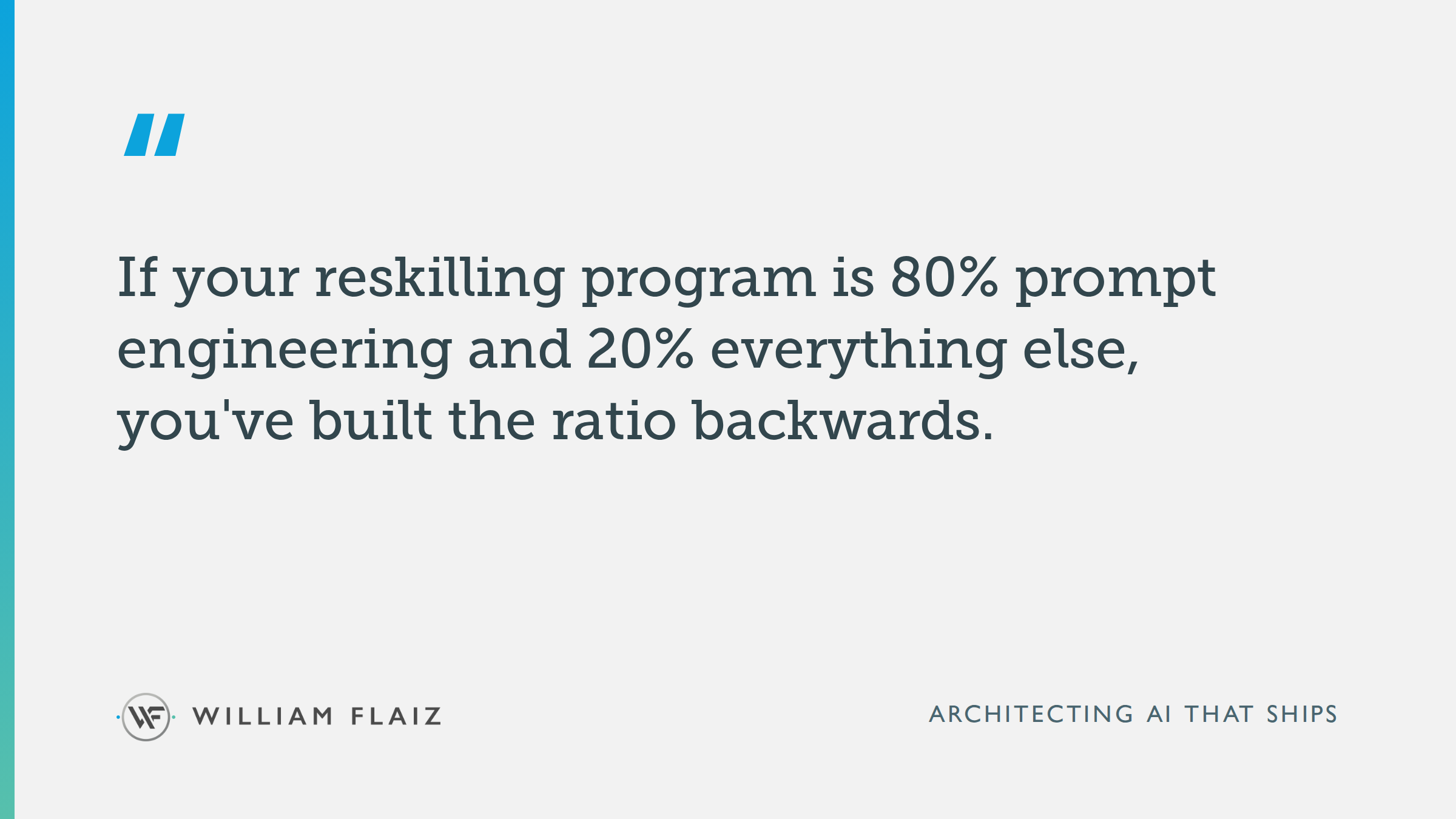
But it's also roughly 80% of what most curricula cover, and it happens to be the 80% of knowledge work that AI systems are getting better at doing without a human in the loop. Summarizing documents, drafting first passes, pulling data together, formatting reports. That's exactly the work agentic AI is being built to absorb.
The remaining 20%, the part of the job that involves reading a room, knowing which regulatory reviewer will push back and why, sensing when a customer's hesitation means something the data hasn't caught yet, is almost never taught. It's assumed. Nobody assumes it should be, and that's the trap.
Defining the 20% That Makes People Irreplaceable
I think about this the way I think about system architecture. You don't harden the parts of a system that are easy to replace, you harden the parts that carry irreplaceable context. In an organization, that context lives in people, not documents.
The 20% breaks down into three capabilities I've watched separate durable careers from ones AI quietly hollowed out: judgment under ambiguity (deciding what to do when the data is incomplete or conflicting), domain fluency deep enough to know when a model's answer is subtly wrong, and relationship capital that lets someone get a stakeholder to actually act on a recommendation.
None of these show up in a typical LMS module. All three compound over years of experience. That's precisely why they're worth building a curriculum around, and why almost nobody has.
What a Proper Capability Program Looks Like
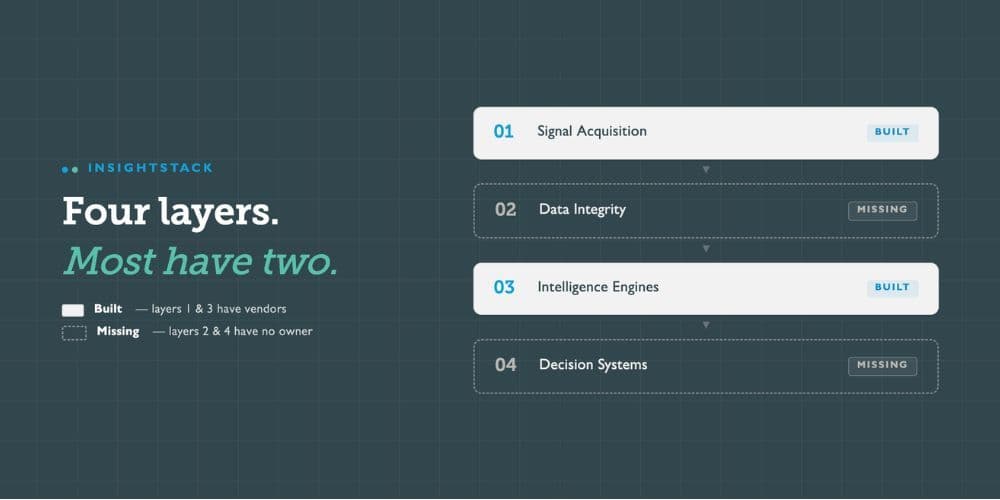
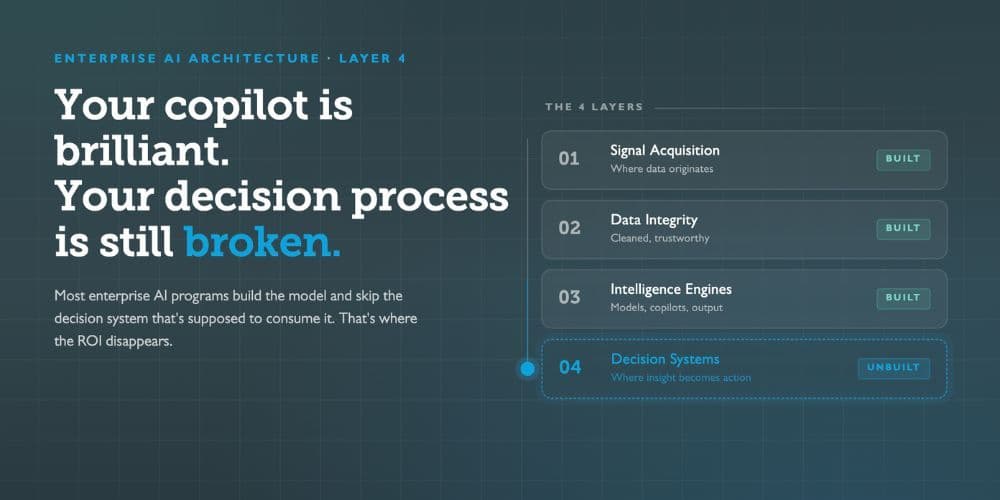
A capability stack that actually protects your workforce needs to be built in layers, not as a single tool-training track.
Here's the framework I use with clients rebuilding their reskilling strategy:
- Layer 1, Tool fluency: the execution skills, kept lean and just-in-time, not the centerpiece
- Layer 2, Judgment simulation: scenario-based training where employees practice decisions with incomplete or conflicting information, graded by senior practitioners, not quizzes
- Layer 3, Domain depth: rotational exposure and mentorship structured to build the pattern recognition that catches a wrong AI output before it ships
- Layer 4, Relationship and influence: explicit coaching on stakeholder navigation, negotiation, and organizational trust building, treated as a trainable skill, not a personality trait
Most programs stop at Layer 1. The ones that actually build workforce resilience spend the majority of their budget on Layers 2 through 4.
Manager Accountability Is the Missing Mechanism
Here's the part nobody wants to hear. You can build the best four-layer curriculum in the world, and it will still fail if managers aren't held accountable for developing it in their people.
At Novartis, the reskilling efforts that actually stuck were the ones where a manager's own performance review included a line item on whether their direct reports had grown in judgment and domain capability, not just tool adoption. The ones that faded were the ones where L&D owned the outcome and managers just approved the training request.
If nobody in the chain of command is measured on whether the 20% is developing, it won't develop. That's not a training problem. That's a management design problem, and it's usually the real reason reskilling budgets underperform.
A Diagnostic for Where Your Organization Stands
Before you commit another dollar to reskilling, ask these four questions honestly.
- What percentage of your current training hours go to tool usage versus judgment, domain depth, or relationship skill?
- Can any manager in your org name the specific judgment gap they're closing in a direct report this quarter?
- Does your performance review process measure capability growth in the 20%, or only tool adoption metrics?
- If AI automated 80% of a role tomorrow, would the remaining 20% of your people be ready to own it?
If you can't answer all four with confidence, you don't have a reskilling program. You have a tool rollout wearing a reskilling program's name.
Frequently Asked Questions
What is the 80/20 capability gap in enterprise AI reskilling?
It refers to the fact that most training budgets go toward the 80% of work that involves tool execution, which AI is increasingly automating, while the 20% involving judgment, domain expertise, and relationship capital gets almost no structured development.
Why do most enterprise AI training programs fail to build lasting workforce capability?
Because they treat AI reskilling as a single tool-adoption track rather than a layered capability stack, and because managers are rarely held accountable for developing judgment and domain skills in their teams.
How can CHROs measure whether their AI reskilling program is working?
Track the ratio of training hours spent on tool usage versus judgment simulation and domain depth, and add capability growth in those areas to manager performance reviews rather than measuring adoption metrics alone.