Your AI Copilot Is Brilliant. Your Decision Process Is Still Broken.
You bought the copilot and nothing changed. Here's why enterprise AI fails at the decision layer — and the Layer 4 redesign it takes to fix it.
The model isn't the bottleneck. The workflow is.
Three months ago, a VP of Operations walked me through her company's AI rollout. Four thousand two hundred seats. Microsoft Copilot. Six months of change management. $3.2 million in licensing and implementation.
"How has it changed how decisions get made?" I asked.
She thought about it. "People write emails faster."
This is not a Copilot problem. The product works. What didn't work was the other half of the equation — the decision architecture the model was supposed to slot into. It was never built.
That pattern is showing up everywhere I look.
The Gap Nobody Puts in the Sales Deck
Enterprise AI investment conversations center on the technology. Which model. Which vendor. Which use cases will generate enough ROI to justify the line item. The demos are compelling. The projections look clean.
What the conversation almost never covers: how, exactly, will this AI's output change what a specific person does at a specific decision point?
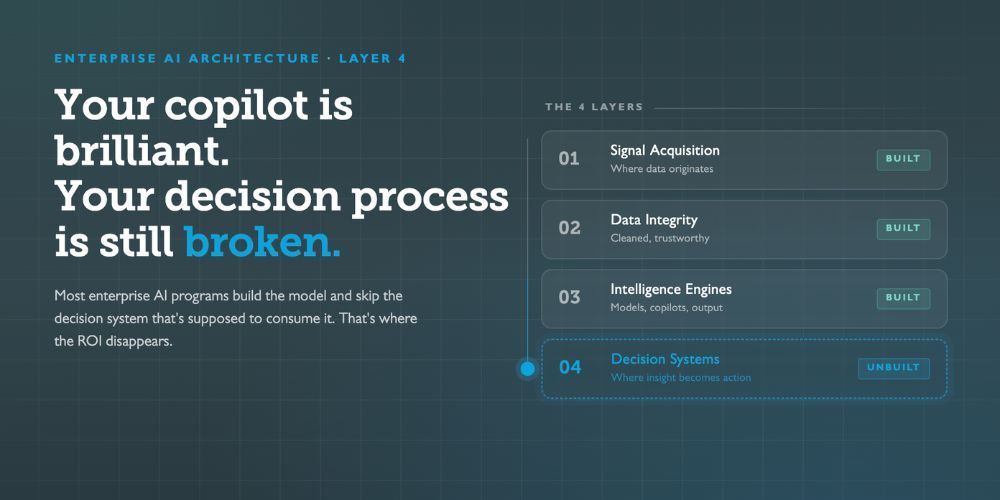
That question is Layer 4. And most companies haven't built an answer to it.
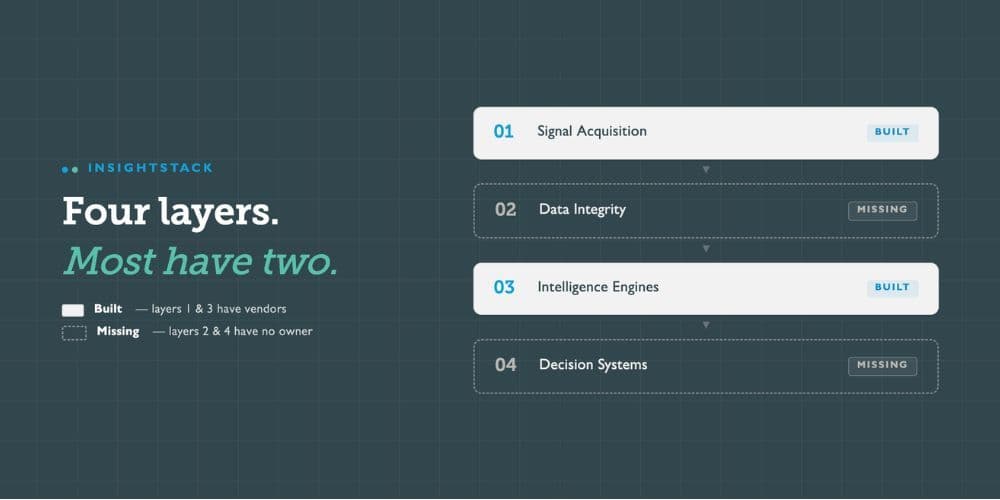
In my InsightStack framework, I describe enterprise AI as a four-layer system. Signal Acquisition (where data originates), Data Integrity (where it gets cleaned and made trustworthy), Intelligence Engines (where models extract structured insight), and Decision Systems (where insight becomes action).
Layers 1 and 3 have vendor categories. They get funded. They get launched. They generate press releases.
Layer 4 requires something no vendor sells: a redesigned decision process. That's change management. That's operations. That's the work nobody puts in the AI budget. So it doesn't happen. And you end up with a copilot that's brilliant and a decision workflow that's exactly where it was before.
The 20% Nobody Has Designed For
Fast Company published a piece recently that framed this from the human side. The premise: AI is absorbing the first 80% of most knowledge work. The last 20% is where irreplaceable human judgment sits — the judgment call, the client read, the contextual awareness no model can replicate.
Here's the enterprise corollary that piece didn't address directly: most companies haven't defined what their 20% is supposed to look like after AI takes the rest.
They bought the copilot to absorb the 80%. Then they handed the output to the same person, on the same timeline, with the same decision heuristics they've always had, and waited for outcomes to change.
The model runs a market analysis. It lands in a SharePoint folder. The analyst reviews it on Monday. Makes a call Wednesday. Same call they'd have made without it.
That's not an AI program. That's an analytics upgrade with a more expensive backend.
The 20% that matters only works when the workflow is explicitly built around it. When the model's output arrives at the right moment, in the right form, with the friction of the old process redesigned to consume it. Without that redesign, you're not capturing the 20%. You're capturing the appearance of it.
What Redesigning a Decision Actually Looks Like
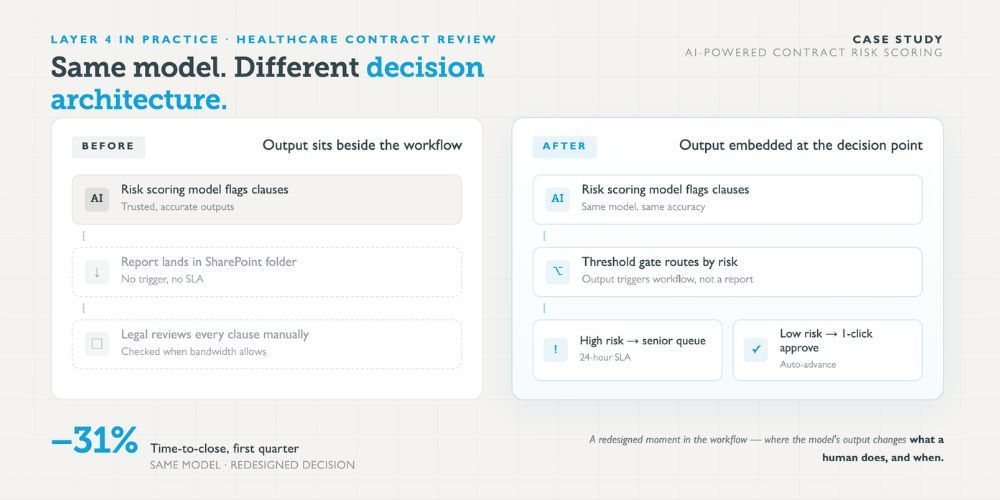
Here's a specific example. A healthcare company I worked with deployed AI-powered contract risk scoring. The model was solid. It flagged high-risk clauses reliably. The legal team trusted the outputs.
Nothing changed. Contracts moved at the same pace. The legal team reviewed every clause manually because the risk scores arrived as a report in a folder they checked when they had bandwidth.
The model wasn't the problem. Layer 4 was missing.
We rebuilt the workflow. High-risk scores above a threshold now route automatically to a senior associate's queue with a 24-hour SLA. Low-risk contracts advance with a one-click approval. The model's output was embedded in the decision point instead of sitting beside it.
Time-to-close dropped 31% in the first quarter. Same model. Different decision architecture.
That's what Layer 4 means in practice. Not a dashboard the right people might check. Not a report that arrives after the call is already made. A redesigned moment in the workflow where the model's output changes what a human does, and when.
A Diagnostic You Can Run This Week
These five questions are what I work through with executive teams before any architecture engagement. Answer them honestly. The point is to see what you have, not to score well.
Not a category. A decision. "Better customer insight" is a wish. "Reducing time-to-approval for Tier 2 contracts" is a decision.
Not the technical owner. The process owner. If these aren't the same person who reviewed the AI vendor contract, Layer 4 is almost certainly unowned.
Before a decision, or after it? "Available on request" means it's a library, not a decision system.
If you can't describe those conditions specifically, the system wasn't designed to change decisions.
If the answer is "none we can measure," Layer 4 isn't built yet.
Most teams I run this with get two or three right. The ones clearing all five are the ones where AI is producing measurable operational change. That's not coincidence.
Run this with your team.
I put these five questions into a printable one-pager — formatted to use in a leadership meeting or drop into a team Slack. Includes answer space and a scoring guide so you know where to focus. Free download, no form.
Download the Decision Systems Diagnostic →
Where to Start
You don't need to redesign every workflow at once. Pick one decision. Not a category — one specific decision inside a specific process. Map the current state. Find the moment where the model's output could change what the decision-maker does. Redesign the process so the output arrives there, in the form it's actually needed, with the old friction removed.
That's your real proof of concept. Not model accuracy. Not adoption rate. The measurable change in how that one decision gets made.
The copilot is probably fine. The model is probably working. What's missing is the decision architecture that turns correct output into changed behavior.
Build Layer 4. The ROI follows.
Frequently Asked Questions
What is Layer 4 in enterprise AI architecture?
Layer 4 — Decision Systems — is where model output gets embedded into actual business workflows. It's the layer that converts correct AI output into changed decisions and changed behavior. Without it, even well-functioning AI produces reports rather than results.
Why do most enterprise AI programs skip building decision systems?
Because it requires something vendors don't sell: process redesign. Layers 1 and 3 (data sources and models) have clean vendor categories. Decision Systems require process owners, workflow redesign, and change management — none of which fit neatly into an AI procurement budget.
How do I know if my AI program has a Layer 4 problem?
Ask this: if you shut off your most prominent AI deployment tomorrow, which business outcomes would visibly degrade? If you can't name one you can measure, you have a Layer 4 problem. The model may be working. The decision process just isn't built around it.