Why AI-Ready Data Is the New Competitive Moat (And How to Know If You Have It)
AI model performance is increasingly a function of data quality, not model selection. Here's how to know if your data is actually AI-ready.
Winning With AI Isn't About the Model
Every board deck I've seen in the last two years has a slide about which model the company is standardizing on. GPT-something, a fine-tuned open source model, a vendor's proprietary layer. It's the wrong slide.
I've now run this comparison three separate times with three different clients: same use case, same vendor, same model version, two different data foundations. The gap in output quality wasn't 10% or 20%. It was the difference between a pilot that got funded for year two and one that got quietly shut down in month four.
The model is a commodity. Every serious enterprise player is within a few percentage points of every other serious enterprise player on raw model capability. What isn't commoditized is whether your data can actually feed that model something useful. That's the moat now.
The Five Dimensions of AI-Ready Data
AI-ready data isn't the same thing as clean data, though clean data is part of it. I break it into five dimensions, and I've never seen an enterprise score well on all five without deliberate work.
Get any one of these wrong and the model doesn't fail loudly. It fails quietly, in ways that look like a model problem until you dig in.
- Accuracy: Does the record reflect reality right now, not reality six months ago when someone last touched the CRM?
- Completeness: Are the fields the model actually needs populated, or is 30% of your customer table sitting on nulls that get silently imputed to zero?
- Consistency: Does 'Q4 revenue' mean the same thing in the finance warehouse as it does in the marketing dashboard the model is querying against?
- Structure: Is the data in a format the model can reason over, or is it trapped in PDFs, screenshots, and legacy schemas nobody documented?
- Freshness: How old is the data by the time it reaches the model, and does that lag matter for the decision the model is making?
A Self-Assessment Framework You Can Run This Week
You don't need a six-month data audit to get a directional answer here. I've walked CDOs through a version of this in a single afternoon using data they already had pulled.
Start with the dataset feeding your highest-priority AI use case, not your whole data estate. Pull a sample of 500 to 1,000 records and score it against the five dimensions above using a simple 1 to 5 scale each. Anything averaging below 3 on a dimension is a leak, and it's a leak that's currently degrading model output whether anyone's noticed it yet or not.
Then trace lineage on that same sample. Where did each record originate, how many systems has it passed through, and how many manual touches happened along the way? At a life sciences client I worked with, a single patient record had passed through 7 systems before reaching the analytics layer feeding their AI triage tool. Each hop introduced its own error rate. By the time the model saw the record, compounded error across those hops sat at 34%. No one had measured that number before we asked for it.
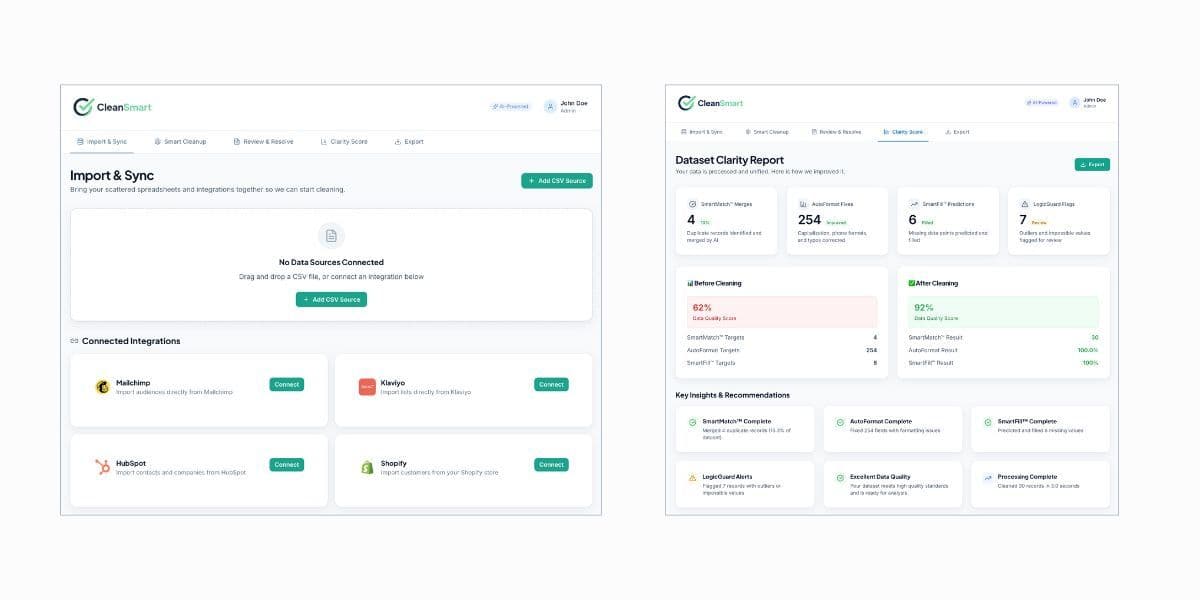
Clarity Score: Turning the Assessment Into an Operating Metric
The framework above is useful once. It's not useful as a monthly practice unless you turn it into a number people can actually track and argue about in a steering committee meeting.
That's why we built Clarity Score inside CleanSmart as a single composite metric across the five dimensions, benchmarked against your own historical baseline and against comparable datasets we've scored across other engagements. It's not a vanity number. It's designed to move when something upstream breaks, so a schema change in a source system or a vendor feed going stale shows up as a score drop before it shows up as a bad model output three weeks later.
One retail client started tracking Clarity Score against a customer 360 dataset feeding their personalization engine. Baseline score was 61 out of 100. After a focused six-week remediation on completeness and consistency (the two dimensions dragging the score down hardest), they hit 84. Click-through on personalized recommendations went from 2.1% to 5.8% on the exact same recommendation model. Nobody touched the model. They touched the data feeding it, and they had a number that proved the work mattered before the business results even landed.
The Competitive Moat Argument
Here's the part that should worry competitive strategy teams more than it currently does. Model access is not a moat. Every competitor in your category can license the same foundation model you're licensing this quarter and a better one next quarter.
AI-ready data compounds instead. Every month you spend closing completeness gaps, standardizing definitions across systems, and cutting lineage hops is a month your data gets structurally harder to replicate. A competitor can't shortcut three years of governance discipline by buying a better model. They have to do the same unglamorous work you did, at the same pace, starting from wherever their data happens to sit today.
I watched this play out at Novartis at a different scale. The 52% cost reduction across 1,200-plus websites didn't come from a smarter CMS. It came from standardizing the underlying content and data model across 90 countries so that whatever tooling sat on top of it actually worked consistently. The tooling changed twice in the years I was there. The data discipline is what compounded.
Start With a Health Check, Not a Model Bake-Off
If your AI roadmap for next quarter starts with a model comparison, you're solving the wrong problem first. Start by scoring the data that's going to feed whatever model you pick.
You can run a free data health check at cleansmartlabs.com/products and get a real read on where your highest-priority dataset stands across accuracy, completeness, consistency, structure, and freshness before you spend another dollar on model selection.
Frequently Asked Questions
What does AI-ready data actually mean?
It means data that scores well across five dimensions: accuracy, completeness, consistency, structure, and freshness. Clean data is a starting point, but AI-ready data also has to be structured for machine reasoning and current enough to matter for the decision at hand.
How do I know if my data is holding back my AI initiatives?
Pull a sample of 500 to 1,000 records from the dataset feeding your priority use case and score it against the five dimensions above. Anything averaging below 3 out of 5 on a dimension is likely degrading model output already, even if no one has traced it back to the data yet.
Why is data quality described as a competitive moat instead of just a technical requirement?
Because model access is easy to replicate and data discipline is not. A competitor can license the same model you use next quarter, but they can't shortcut years of governance and lineage cleanup, so the gap compounds in your favor the longer you invest in it.