Your CRM is Lying to You: Why Dirty Data is Costing SMBs Thousands
Your CRM looks full, but duplicates, bad formatting, and gaps cost SMBs thousands a year. Here's how to find and fix the problem fast.
That expensive CRM you bought last year? It's only as good as the data inside it. And yours is probably a mess.
Last quarter, I sat down with the founder of a 200-person SaaS company. She'd spent $85,000 on a CRM migration. New platform, new integrations, new training for the entire sales team. Three months post-launch, her VP of Sales pulled me aside and said something I've heard dozens of times now:
"We're worse off than before."
Not because the CRM was bad. The technology was fine. The problem? They'd migrated 47,000 contact records from their old system, and roughly 30% of them were duplicates, outdated, or flat-out wrong. They'd spent six figures moving garbage from one shiny container to another.
This is the story nobody tells you about CRM implementations. The software isn't the bottleneck. Your data is.

The $12.9 Million Problem Most SMBs Ignore
According to industry research, poor data quality costs businesses an average of $12.9 million annually. Now, that's an enterprise figure. Scale it down to a mid-market company running 50 to 500 employees, and you're still looking at tens of thousands in wasted spend, lost deals, and misallocated marketing budget every single year.
Here's what makes it worse: most SMBs don't even know it's happening.
Your CRM shows 15,000 contacts. Feels impressive, right? But how many of those are the same person entered three different ways? "John Smith" from his business card, "Jon Smith" from a webinar registration, "J. Smith" from an old spreadsheet import. Your system counts that as three separate leads. Your sales team might chase all three. Your email platform charges you for all three.
The CRM isn't lying on purpose. It's showing you what you gave it. And what most of us gave it, over months and years of imports, manual entries, and half-finished integrations, is a mess.
Four Hidden Ways Dirty Data Bleeds You Dry
I've audited MarTech stacks for companies ranging from $10M startups to Fortune 100 enterprises. The patterns are eerily consistent. Dirty data doesn't announce itself with a big red warning. It erodes performance quietly, in ways that are easy to rationalize until you add them up.
1. You're Overpaying for Email and Marketing Automation
Most email platforms and marketing automation tools price by contact count. Mailchimp, HubSpot, Klaviyo -- they all do it. If 20% of your list is duplicates (a conservative estimate for companies that haven't cleaned their data in over a year), you're paying a 20% premium for sending emails to the same people twice. Or worse, to addresses that bounce.
I worked with an e-commerce brand that had 62,000 contacts in Klaviyo. After a proper deduplication pass, they were down to 48,000 unique, deliverable addresses. That's a 22% reduction. The savings on their monthly Klaviyo bill alone covered the cost of the cleanup, and their open rates jumped because they stopped diluting metrics with bounced and duplicate sends.
2. Sales Reps Waste Hours on Phantom Leads
Your sales team is probably spending time on leads that don't exist. Not intentionally -- the CRM told them those leads were real. A duplicated contact might get assigned to two different reps, creating internal conflict and a confused prospect who gets the same pitch from two people at your company. That's not a great look.
Then there's the dead weight: contacts with wrong phone numbers, outdated email addresses, company names that haven't existed since the last acquisition cycle. Your reps don't know which records are good until they've already invested time working them. Every minute spent chasing a bad record is a minute not spent closing a real deal.
3. Your Segmentation is Broken (So Your Campaigns Underperform)
Personalization at scale depends entirely on accurate segmentation. Segment by industry, company size, purchase history, engagement level. All of that falls apart when the underlying data is inconsistent.
If "Healthcare" appears as "healthcare," "Health Care," "HC," and "Medical" across your records, your segment for healthcare prospects is missing a huge chunk of your actual healthcare contacts. Your carefully crafted campaign goes to half the audience it should. The numbers come back weak, and someone in the room suggests the messaging was off. Maybe it was. But the real culprit was data quality, and nobody checked.
4. Executive Decisions Based on Bad Numbers
This one keeps me up at night. When the CEO asks, "How many active customers do we have?" or the board wants to see pipeline coverage ratios, those answers come from CRM data. If 15-30% of your records are duplicated or inaccurate, every report built on that data is wrong.
I've seen companies overstate their customer count by 25% because of duplicate records. That kind of error doesn't mislead -- it distorts strategy. You might think you're growing when you're stagnant. You might think a market segment is underperforming when your data isn't capturing it correctly.
This is what I mean when I say MarTech failure isn't about technology. It's about the data underneath.
Why This Hits SMBs Harder Than Enterprises
Big companies have data governance teams. They've got MDM platforms, dedicated analysts, and quarterly data quality reviews baked into their operating model. They still struggle with dirty data, but at least they have resources to throw at the problem.
SMBs don't have that luxury. The "data team" is usually a marketing manager who also handles campaign ops, or a sales ops person splitting time between reporting and CRM administration. Nobody's job title includes "data quality," so nobody owns it. And manual cleanup? That's a soul-crushing task. I've watched talented marketers spend entire weeks in spreadsheets trying to deduplicate a 30,000-row export, matching names by eye, checking email patterns, guessing which record to keep.
That's not a good use of anyone's time. And it doesn't scale.
What a Fix Looks Like (Without Hiring a Data Team)
The traditional approach to data cleaning is painful: export everything to CSV, open it in Excel, spend days sorting and filtering, pray you don't accidentally delete real records, then re-import and hope nothing breaks. I've been through this cycle with multiple clients, and it's the reason I built CleanSmart.
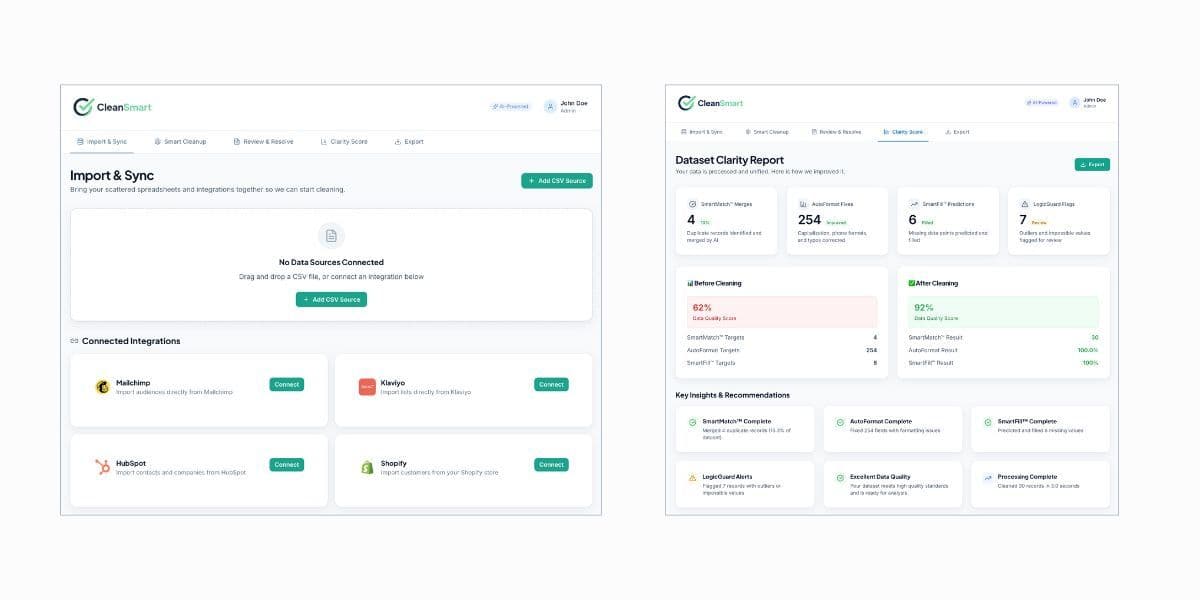
CleanSmart runs your data through a four-step automated pipeline: AI-powered duplicate detection that uses semantic matching (it knows "Bob" and "Robert" might be the same person at the same company), format standardization for phone numbers, emails, and addresses, intelligent gap-filling for missing fields, and anomaly detection that flags records that don't pass the smell test.
The semantic matching piece is what changes the game. Traditional deduplication tools compare exact strings. If "Jon Smith" and "John Smith" don't match character-for-character, they stay as separate records. CleanSmart looks at meaning -- name similarity combined with email patterns, company names, phone numbers -- and catches duplicates that string-matching misses entirely.
And because it connects directly to platforms like Mailchimp, HubSpot, Klaviyo, and Shopify, you don't need to deal with the CSV export-import cycle. Pull your data in, clean it, push it back. Every change gets logged in a complete audit trail, which matters if you're thinking about GDPR or CCPA compliance.
The First Step Is Easier Than You Think
You don't need a six-month data governance initiative. Start with an audit.
Pull a sample of 500 records from your CRM. Check how many have complete contact information. Look for obvious duplicates. Count the number of records with inconsistent formatting in key fields like phone numbers or company names. If more than 10% have issues, your full database has a problem worth fixing.
Try CleanSmart free to run that audit automatically. Upload a CSV or connect your CRM, and you'll see exactly how dirty your data is within minutes. No spreadsheet gymnastics required.
Because the CRM isn't the problem. And the marketing automation isn't the problem. The data feeding both of them? That's where the money's leaking.
Frequently Asked Questions
How do I know if my CRM data is "dirty"?
Pull a random sample of 500 records and check three things: Are there obvious duplicates (same person, slightly different name spellings)? Do key fields like phone numbers and emails follow a consistent format? Are more than 10% of records missing critical information like email or company name? If you spot issues in your sample, the full database is almost certainly worse. Most companies that haven't done a data cleanup in 12+ months find that 15-30% of their records have quality issues.
Can't I clean my data manually in a spreadsheet?
You can, but it doesn't scale. Manual deduplication works for a few hundred records. When you're dealing with 10,000 or 50,000+ contacts, eyeballing names in a spreadsheet misses semantic duplicates ("Bob" vs. "Robert"), takes days or weeks of focused effort, and carries real risk of accidentally deleting valid records. AI-powered tools that understand name variations, email patterns, and company context catch duplicates that manual review misses while completing the job in minutes instead of weeks.
How often should I clean my CRM data?
At minimum, run a data quality audit quarterly. If your team imports new contacts frequently through trade shows, webinar registrations, or purchased lists, monthly cleaning is better. The most effective approach is preventive: set standardized data entry rules for your team, validate records at the point of entry, and schedule automated cleaning runs so quality never degrades to the point where it impacts campaigns or reporting.